
What the Deep Ocean Knows: The Case for Deep Sea Water in Modern Nutrition
Below 200 meters, the ocean holds a mineral profile that modern diets rarely replicate — and ingredient science is finally catching up.
Modern nutrition has a mineral problem. Despite abundant food supplies, chronic mineral deficiencies — magnesium in particular — are widespread across developed and developing markets. The causes are well-documented: industrial farming has depleted mineral content from soils, processed food dominates caloric intake, and high-stress modern lifestyles increase mineral turnover faster than most diets can replenish. Into this gap steps one of the most chemically stable, sustainably abundant mineral sources on the planet: deep sea water.
What makes deep sea water different
Deep sea water (DSW) is sourced from below 200 meters, where it remains isolated from surface pollution, photosynthetic activity, and temperature fluctuations. Because of the ocean's thermohaline circulation — the slow, global movement of water driven by temperature and salinity differences — DSW represents ancient, cold, pathogen-free water that has been concentrating minerals over millennia.
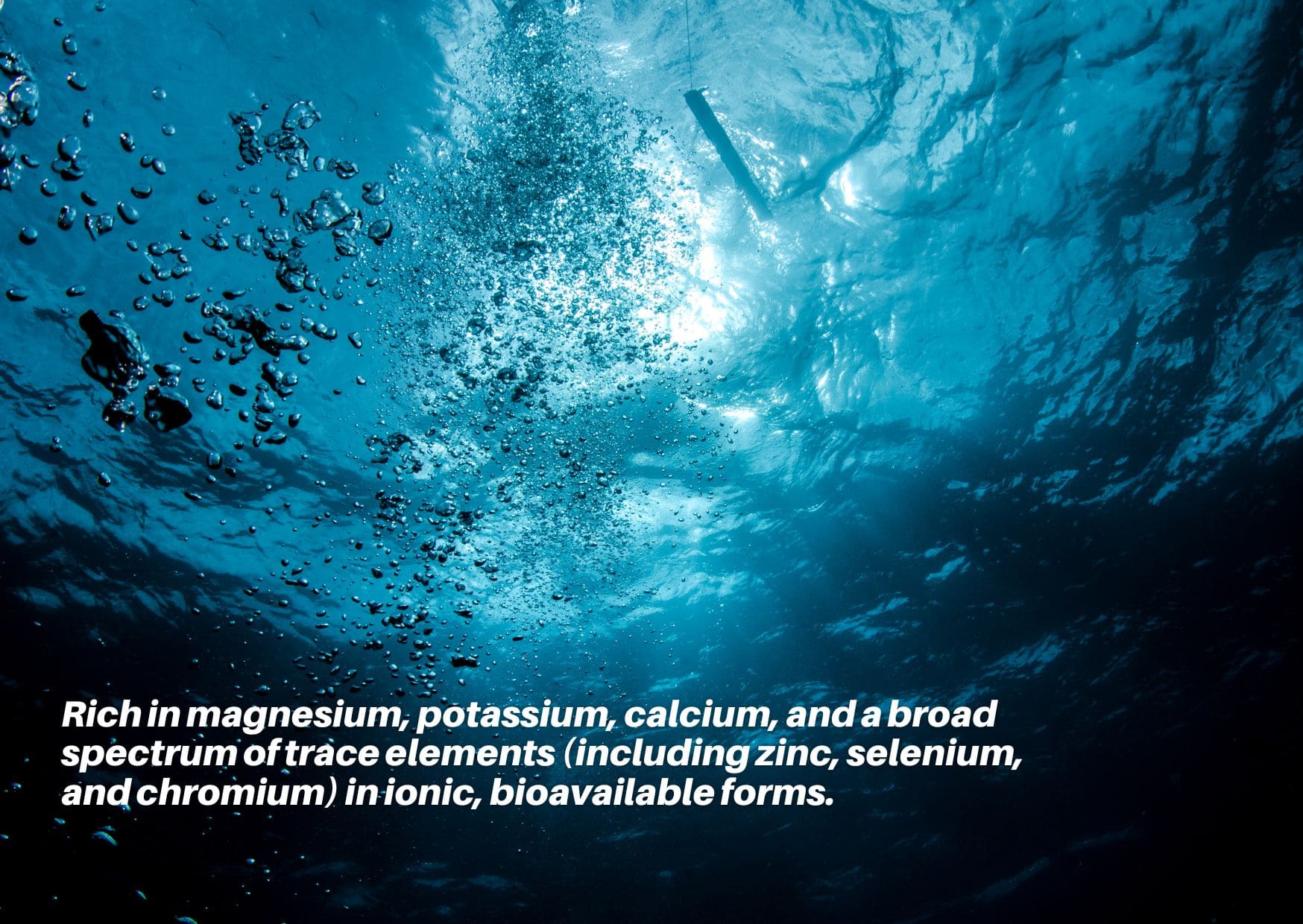
The mineral profile of DSW is distinctive: it is rich in magnesium, potassium, calcium, and a broad spectrum of trace elements (including zinc, selenium, and chromium) in ionic, bioavailable forms. Unlike synthetic mineral supplements, DSW minerals occur in ratios that closely mirror those found in human body fluids — a natural synergy that research suggests may translate into better absorption and utilization.
Why it matters for health formulators
Three areas of interest stand out for B2B formulators:
● Hydration and electrolyte balance. DSW's mineral-rich profile makes it a natural fit for electrolyte and hydration formulations. As the sports nutrition and functional beverage categories evolve beyond simple sodium-potassium formulas, DSW offers a more complex, naturally derived electrolyte matrix.
● Cardiovascular and metabolic support. Magnesium plays roles in over 300 enzymatic reactions, including those governing blood pressure regulation, glucose metabolism, and cardiac rhythm. Magnesium deficiency is associated with hypertension, insulin resistance, and cardiovascular risk — areas where DSW supplementation has attracted growing research interest.
● Bone health. The calcium and magnesium content of DSW, in naturally balanced ratios, makes it relevant to bone density formulations, particularly for post-menopausal women and older adults where bone mineral loss accelerates.
Hi-Q's approach: DC-Minerolz™
DC-Minerolz™ is Hi-Q's branded deep sea water mineral ingredient, sourced from the Pacific Ocean's deep-water resources accessible from Taiwan's eastern coast. Taiwan sits on one of the world's most geologically active marine shelves, where deep, cold Pacific currents rise close to the coastline — making it an ideal location for sustainable DSW extraction.
DC-Minerolz™ undergoes Hi-Q's proprietary processing to concentrate the naturally occurring mineral spectrum while preserving ionic bioavailability. It is produced in ISO 22000 and HACCP-certified facilities, HALAL certified, and positioned for use in functional beverages, dietary supplements, mineral waters, and nutraceutical blends.
A clean-label story brands can tell
Consumer interest in marine-derived ingredients continues to climb, driven by the broader "blue economy" narrative and growing skepticism toward synthetically derived minerals. DC-Minerolz™ gives brands a credible, clean-label origin story: minerals from deep, cold, sustainably sourced Pacific seawater, with zero agricultural land use, zero freshwater consumption, and a natural mineral profile that resonates with ingredient-aware consumers.
→ Request a DC-Minerolz™ sample | Talk to our B2B team
Reference
Rosanoff, A. et al. (2012). Suboptimal magnesium status in the United States: are the health consequences underestimated? Nutrition Reviews, 70(3), 153–164.
Del Gobbo, L.C. et al. (2013). Circulating and dietary magnesium and risk of cardiovascular disease. American Journal of Clinical Nutrition, 98(1), 160–173.
*This article is for informational and B2B educational purposes only and does not constitute medical advice. These statements have not been evaluated by the FDA. This product is not intended to diagnose, treat, cure, or prevent any disease.
Related Hi-Q Products