Oligo Fucoidan Supports Liver Cancer Treatment
This article summarizes clinical research on low
molecular weight fucoidan (LMF), also known as Oligo Fucoidan, in liver
cancer (hepatocellular carcinoma, HCC) treatment. The study specifically
used Oligo Fucoidan supplied by Hi-Q Marine Biotech.
Seaweed-Derived Fucoidan
Enhances TACE Therapy
Liver cancer is one of the leading causes of
cancer-related deaths worldwide. For patients with unresectable tumors, transarterial
chemoembolization (TACE) is a standard treatment. However, TACE is often
associated with tumor recurrence and liver function damage.
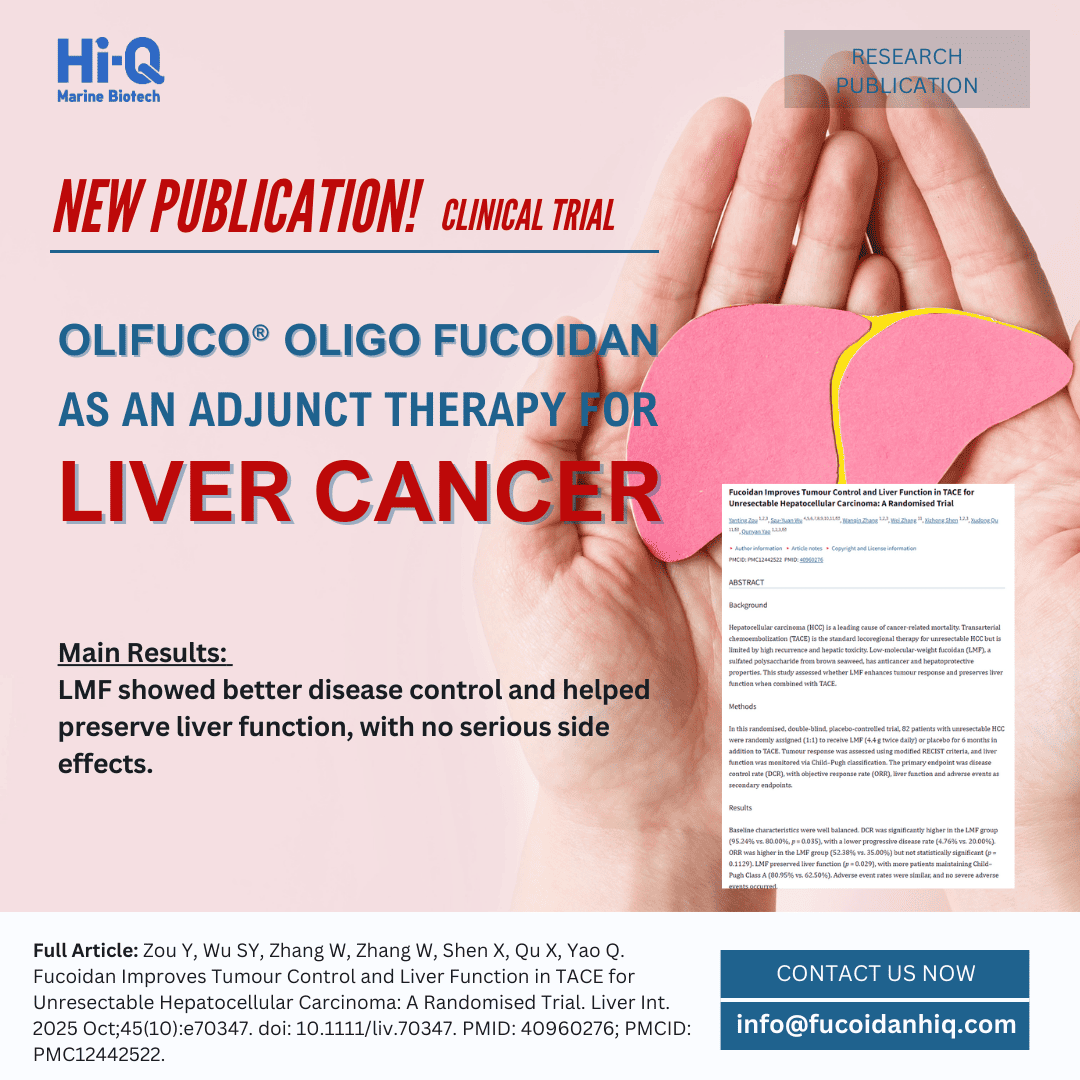
A randomized, double-blind clinical trial
published in Liver International evaluated 82 HCC patients
undergoing TACE. Participants received either 4.4 g/day of Hi-Q Marine
Biotech’s Oligo Fucoidan or a placebo for six months.
Key Clinical Benefits
-
Improved tumor control:
The Oligo Fucoidan group achieved a 95.24% disease control rate, compared to 80.00% in the placebo group, with significantly lower tumor progression. -
Better liver function preservation:
80.95% of patients taking Oligo Fucoidan maintained Child-Pugh Class A liver function, versus 62.50% in the placebo group.
Why Oligo Fucoidan Works
Oligo Fucoidan from Hi-Q Marine Biotech exhibits anti-inflammatory, antioxidant, anti-angiogenic, and
immune-modulating properties, helping reduce oxidative stress and protect
healthy liver cells during cancer treatment. The study also confirmed good
safety and tolerability, with no increase in serious adverse events.
Conclusion
This clinical study provides evidence that Hi-QMarine Biotech’s Oligo Fucoidan is a promising adjunct therapy for liver
cancer patients receiving TACE, supporting tumor control while protecting
liver function.
Disclaimer:
This content is based on a 2025 published clinical study and is for
informational purposes only. It does not replace professional medical advice.
Patients should consult healthcare professionals before use.
Reference: https://pmc.ncbi.nlm.nih.gov/articles/PMC12442522/